
What Counts as Taxable Crypto Income in 2026? A Practical Identification Guide
As 2026 begins, the IRS has fully integrated cryptocurrency into the standard reporting system used for stocks and bonds. Many crypto investors are unsure which activities trigger taxes. Buying, selling, earning, or transferring, some actions are taxable, while others are not.
The IRS treats cryptocurrency as property. This means most crypto transactions fall under capital gains or ordinary income rules. Starting this year, you will receive Form 1099-DA from custodial platforms. This form reports your activity directly to the IRS, making it essential to identify taxable events accurately to avoid "mismatch" notices.
In this guide, you’ll learn what counts as taxable crypto income in 2026 for U.S. taxpayers, how to identify taxable events, and how to handle the mandatory cost-basis reporting rules under the new 1099-DA framework.
Key Takeaways
Selling, trading, or spending cryptocurrency creates taxable capital gains events that must be reported.
Crypto earned from mining, staking, airdrops, or payments is taxed as ordinary income at fair market value when received.
Accurate records of dates, values, transaction IDs, and cost basis are critical under the new 1099-DA rules.
Proper identification and reconciliation of taxable events is the best defense against IRS notices and audits.
Types of Taxable Crypto Income
The IRS recognizes several categories of cryptocurrency activity that generate taxable income. Knowing how each one is treated is essential for accurate reporting.
Crypto Received as Payment
If you receive cryptocurrency as payment for work, goods, or services, it is taxed as ordinary income. The taxable amount is the fair market value (FMV) in USD at the time you receive the crypto.
This applies to salaries, freelance payments, and business exchanges.
This income is taxed according to your 2026 income tax bracket.
Mining & Staking Rewards
Rewards are considered ordinary income based on their FMV on the day you gain "dominion and control" over them.
Even if your exchange doesn't include these rewards on a 1099-DA, they are still taxable as income the moment they hit your wallet.
Airdrops and Hard Forks
Airdrops and hard fork rewards are taxable only when you receive the new crypto and can access it. The taxable amount is the FMV at the time you gain control of the coins.
Interest and Yield Income
Crypto earned from lending platforms or yield farming is treated as ordinary income, taxed at its FMV when received.
How to Identify Taxable Crypto Events
A simple rule helps clarify most crypto tax questions: Any transaction where you dispose of cryptocurrency is a taxable event.
Taxable Crypto Activities Include:
Selling crypto for fiat (USD, EUR, etc.).
Trading one cryptocurrency for another (e.g., swapping BTC for ETH).
Using crypto to buy goods or services.
Receiving crypto as payment, rewards, or income FMV at the time you gain control of the coins.
Non-Taxable Activities Include:
Holding crypto in a wallet without selling or trading.
Buying crypto with fiat currency (USD).
Transferring crypto between your own wallets (e.g., Ledger to Coinbase).
While transfers aren't taxable, the IRS now requires per-wallet tracking. You must be able to prove that a transfer to an external wallet was a "self-transfer" and not a sale to avoid it being flagged on a 1099-DA.
Records You Must Keep
To correctly identify and calculate taxes, and to correct any errors on your exchange-issued 1099-DA, you must track:
Purchase and sale dates.
Transaction IDs (TXIDs) for all on-chain movements.
Fair market value at the time of each transaction.
Cost Basis: For assets acquired after Jan 1, 2026, brokers are required to track and report your cost basis. For older assets, you must provide this yourself.
How to Report Crypto Income on Your Taxes
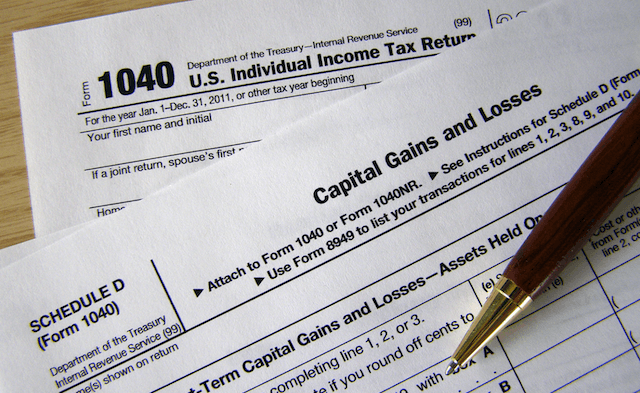
In 2026, you must reconcile your personal records with the Form 1099-DA provided by your exchange.
Capital Gains Reporting Use Form 8949 and Schedule D to report:
Crypto sales and swaps.
Purchases made using crypto.
You must indicate on Form 8949 if the cost basis was reported to the IRS by your broker.
Ordinary Income Reporting
Schedule C: For professional mining or freelance payments.
Schedule 1 (Line 8z): For "Other Income" like staking, airdrops, and interest.\
The 1099-DA Role in early 2026, you will receive your first Form 1099-DA for your 2025 activity. However, for 2026 trades, the 1099-DA is even more detailed, requiring "covered asset" reporting (basis and dates).
Most Common Crypto Tax Mistakes and How to Prevent Them
Ordinary Income Reporting
Brokers often don't see your activity on Decentralized Exchanges (DEXs) or private wallets.
Fix: Use crypto tax software to aggregate your DEX trades and private wallet history into a single report.
Incorrect Basis on Transfers
If you move BTC from a private wallet to an exchange and then sell it, the exchange may report a $0 cost basis to the IRS because they don't know what you originally paid.
Fix: Manually adjust your basis on Form 8949 and keep your original purchase records as proof.
Missing the Wash Sale Exception
As of early 2026, crypto is generally not subject to the "Wash Sale" rule.
Fix: You can still sell an asset at a loss to lower your tax bill and buy it back immediately (Tax-Loss Harvesting).
Conclusion
With the full rollout of Form 1099-DA, the IRS now has a clear window into your exchange activity. Identifying taxable events correctly, and maintaining the records to back them up, is your best defense against audits. Proper documentation is no longer optional; it is the foundation of a safe 2026 tax filing.
FAQs
What crypto activities are taxable?
Selling crypto, trading one coin for another, using crypto for purchases, and receiving crypto as income are all taxable events.
Is there a minimum amount before crypto is taxed?
No. All realized gains are taxable regardless of amount, even if no tax form is issued.
How is crypto income taxed?
Crypto income is taxed either as ordinary income or capital gains, depending on how it was earned and disposed of.
Written by:
Andrew Harder




About me

Hi there 👋 I’m Andrew, with 10+ years in bookkeeping and 5 years in crypto, helping investors track and manage their portfolios with practical systems.
FOLLOW US FOR MORE